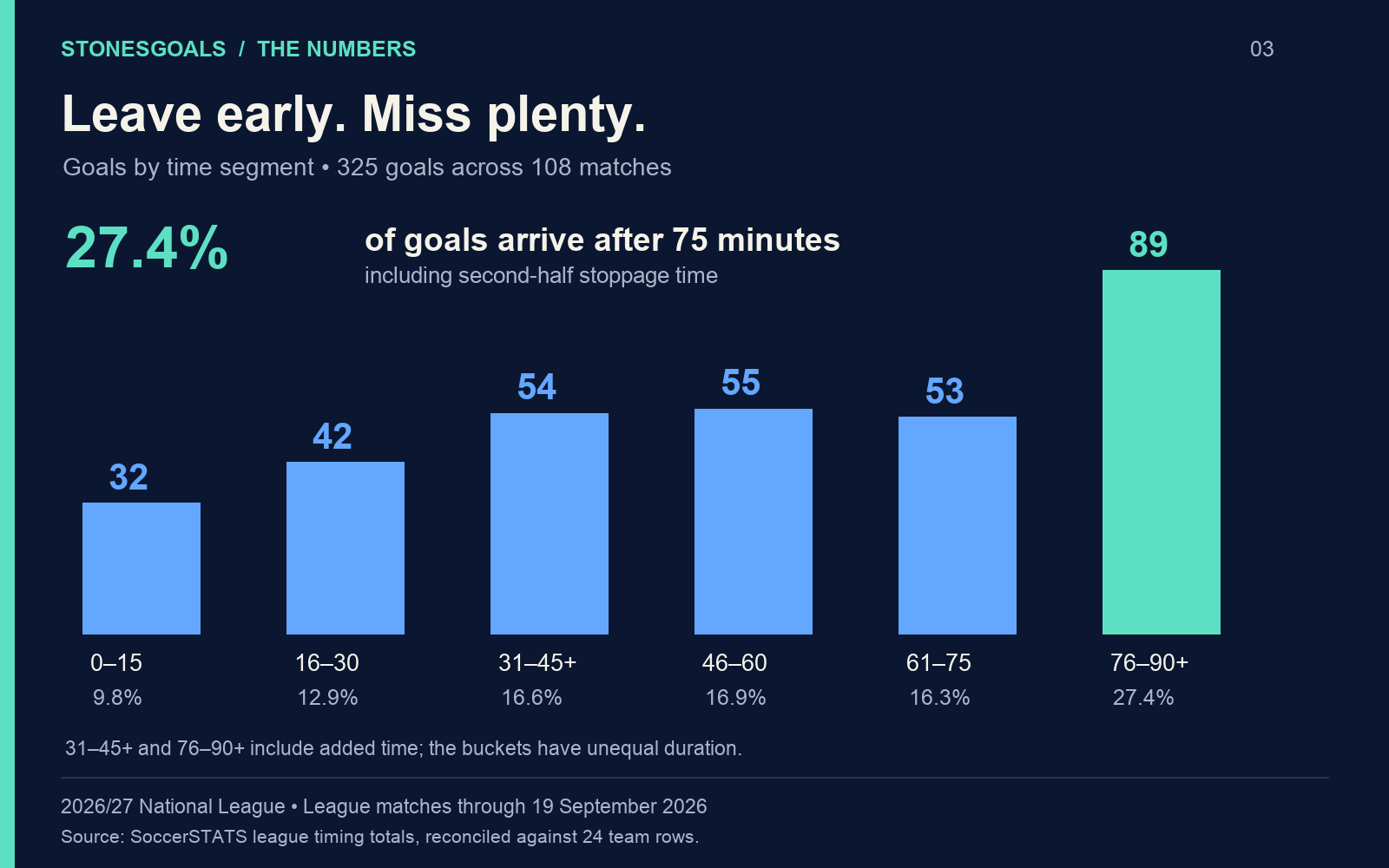
2026/27 National League. League matches through 19 September 2026; researched 23 September. Cups and friendlies excluded.
Four afternoons at the Vale. Three defeats. One point. Wealdstone’s season has acquired a rather uncomfortable centre of gravity.
The Stones can win on the road. They can recover from going behind. What they have not yet managed is to make home feel like an advantage. For a club hoping to move the conversation beyond another survival argument, that is a fairly fundamental problem.
After nine league games, Wealdstone sit 20th with eight points, outside the bottom four on goal difference. Eleven scored, 15 conceded. The position is precarious, but the detail is more useful than another round of general despair. The league table tells us where they are. The split between home and away begins to explain it.
The Vale is giving too much away
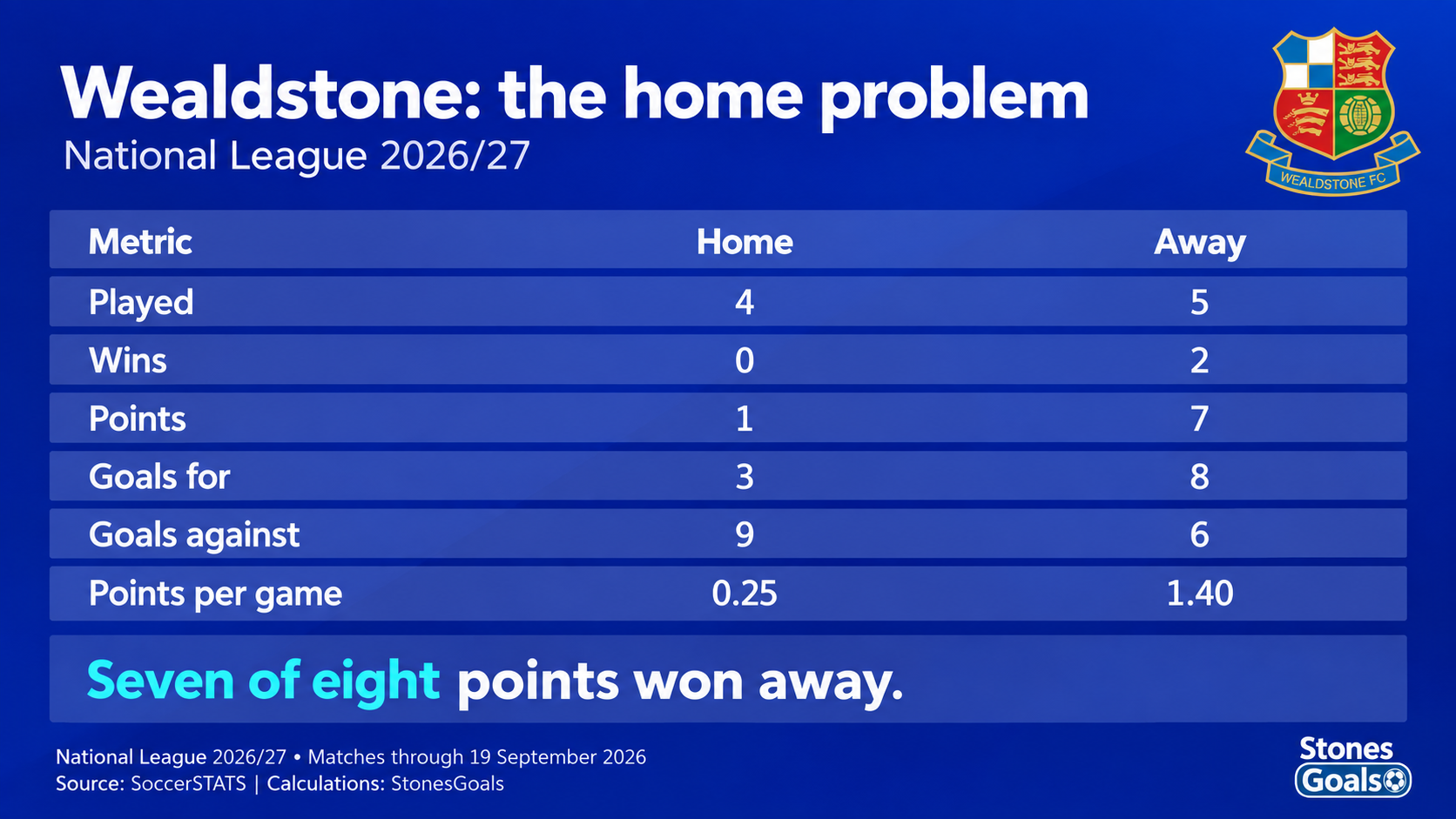
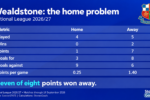
At home, the Stones have scored three and conceded nine. Away, they have scored eight and conceded six. Their points return jumps from 0.25 per game at the Vale to 1.40 on their travels. The home total is the lowest in the division. That is too large a gap to ignore, even this early.
It does not prove that the team is frightened of its own ground, or that one formation works and another does not. Four matches cannot carry that weight. It does tell Waddock where the most immediate improvement has to come.
The interval is not providing a reset
The home half-time scores are revealing: 1–1 against Harrogate, 0–1 against Carlisle, 1–1 against Kidderminster and 0–0 against Halifax. Three level games at the break became defeats. The only home point came from the match in which Wealdstone were behind. See the August and September match logs.
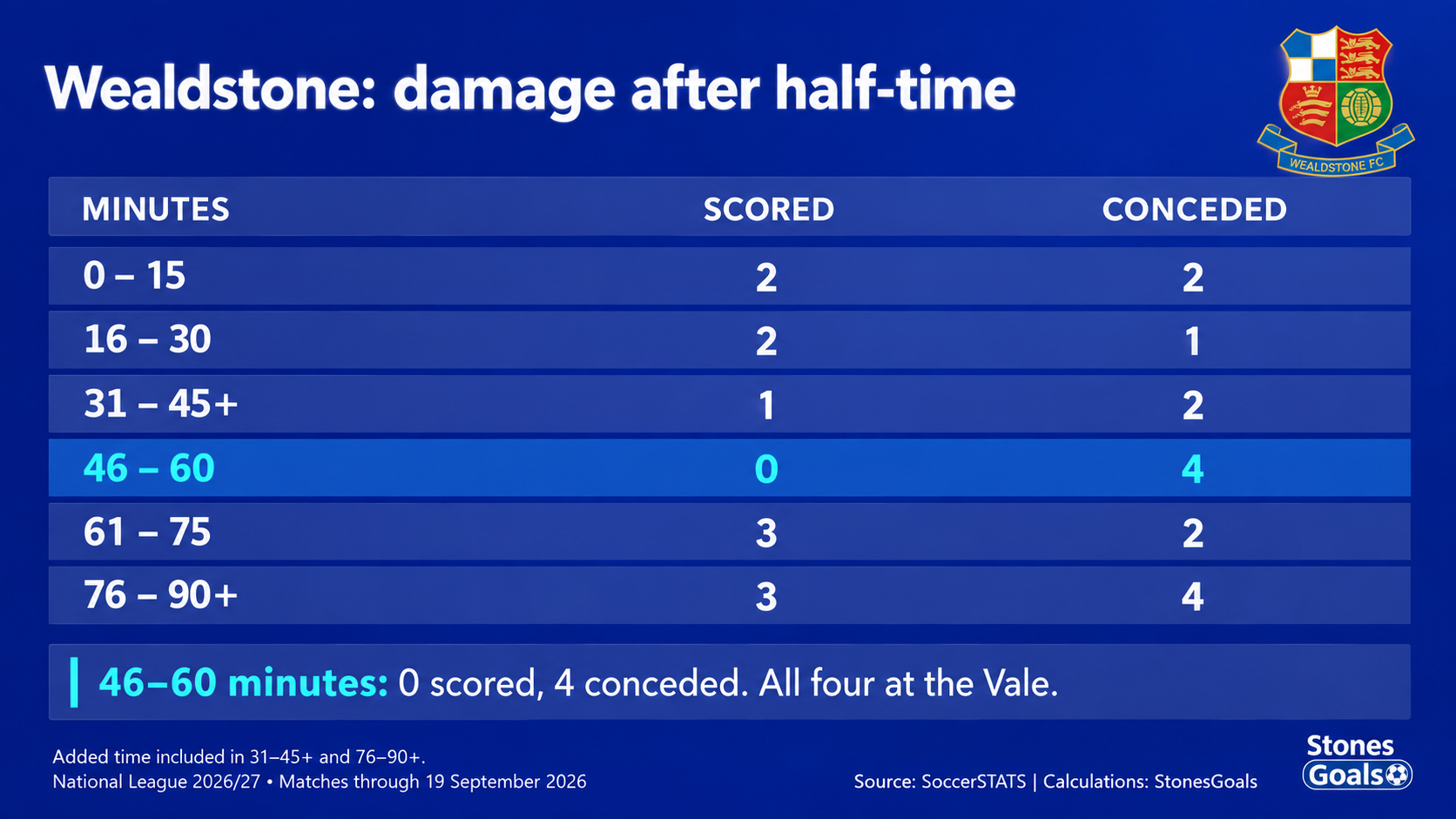
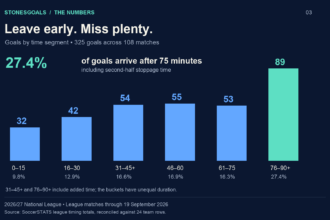
Across the season, the 46th to 60th minutes have produced four opposition goals and none for the Stones. All four concessions came at home. The opening quarter-hour after the restart has repeatedly turned a manageable afternoon into a chase. Goal-timing data.
Halifax supplied the latest example. The club’s match report describes a quiet first half, then a parried shot and a loose ball that Wealdstone failed to clear before Amari Morgan-Smith scored. It also describes the lack of a convincing response. That is a more specific concern than simply being unlucky: conceding the decisive goal and then struggling to ask enough questions.
Tamworth hurt for a different reason
At the Lamb, Wealdstone actually had something to protect. Olomola’s opener survived until the second half, before McAvoy conceded a penalty and was sent off. Tshikuna equalised; Jake Hutchinson settled it in added time. The official report makes the turning point clear. This defeat cannot sensibly be reduced to the same explanation as the Halifax game.
It did, however, leave another promising position without a return. Waddock needs control when his side is level and composure when it is ahead. At present, neither feels dependable enough.
There is something here to rescue
The 2–0 win at Sutton and 3–1 recovery at Boston matter. They show that this group can produce an effective performance and finish it. Boston also required a penalty save from Baptiste, a reminder that even the better afternoons have involved narrow escapes.
The summer preview questioned whether the squad had enough depth and proven quality. These results do not establish recruitment as the cause of every mistake. They do make the demand on the available players clearer: stop turning level home games into defeats, and give the attack a platform that lasts beyond half-time.
Nine games leave time to change the story. The next chapter has to include a home win.
Data note: Snapshot through 19 September 2026, not a live feed. Goal times use SoccerSTATS segment conventions; 31–45 and 76–90 include added time. Small samples and differing opponents limit causal conclusions. Linked club reports provide match context.