2026/27 National League. League matches through 19 September 2026; researched 23 September. Cups and friendlies excluded.
Score first. Settle down. See it out. A perfectly reasonable plan, until the National League starts interfering with it.
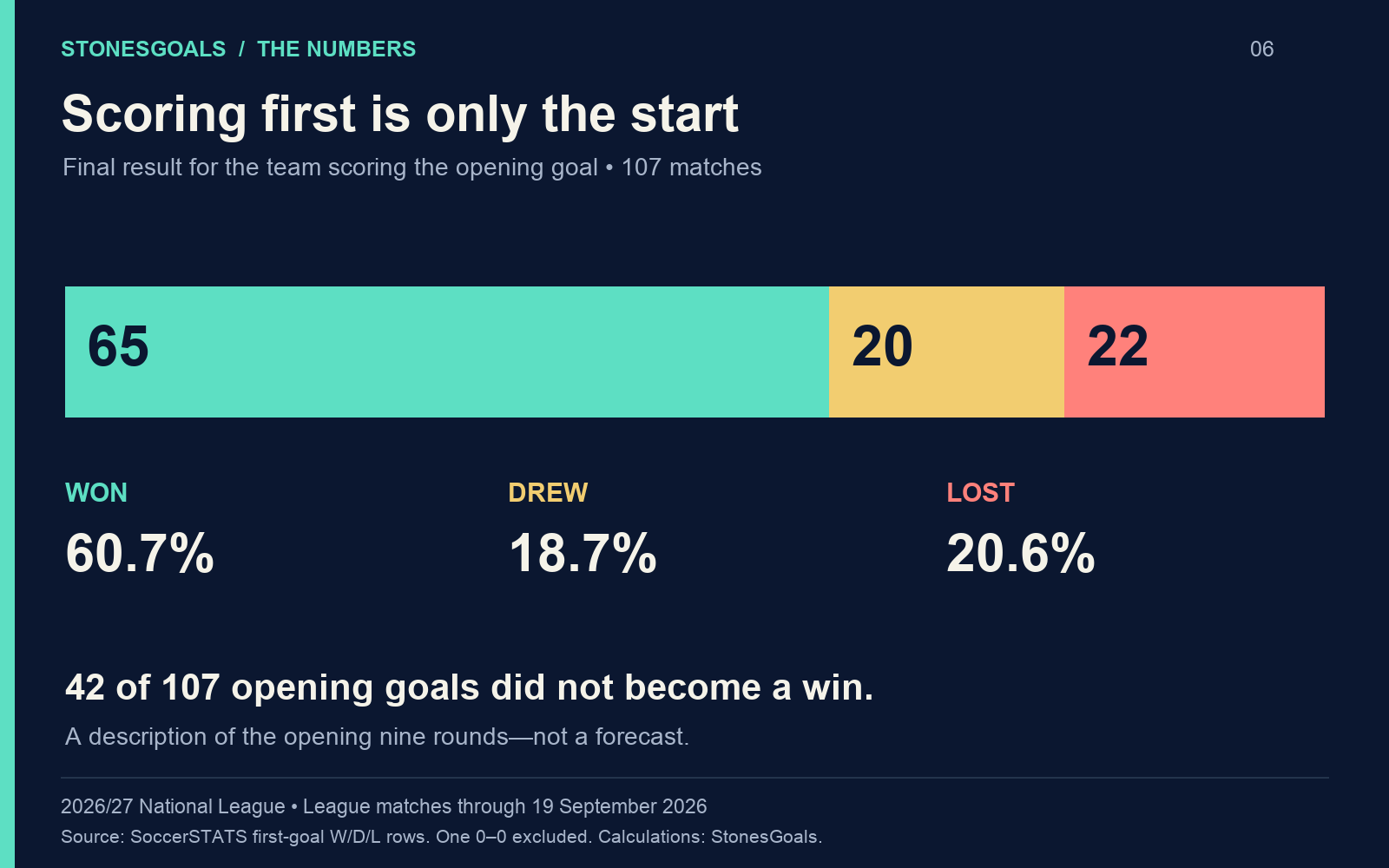
Across the opening nine rounds, the team scoring first won 65 of the 107 matches containing a goal. Twenty finished level and 22 ended in defeat for the side that broke the deadlock. In 39.3% of those games, the first celebration did not become a win. Calculated from SoccerSTATS’ scoring-first outcomes.
Eleven points left on the pitch
Boston, Worthing and Solihull have each dropped 11 points in matches where they scored first. Boston and Worthing opened the scoring seven times apiece, each returning three wins, a draw and three defeats. Solihull did it five times, taking one win, a draw and three defeats.
The calculation is straightforward: two points dropped for a draw after scoring first, three for a defeat. It counts each match once. It is deliberately narrower than points lost from every winning position; a team that concedes first, goes ahead and then loses is outside this measure.
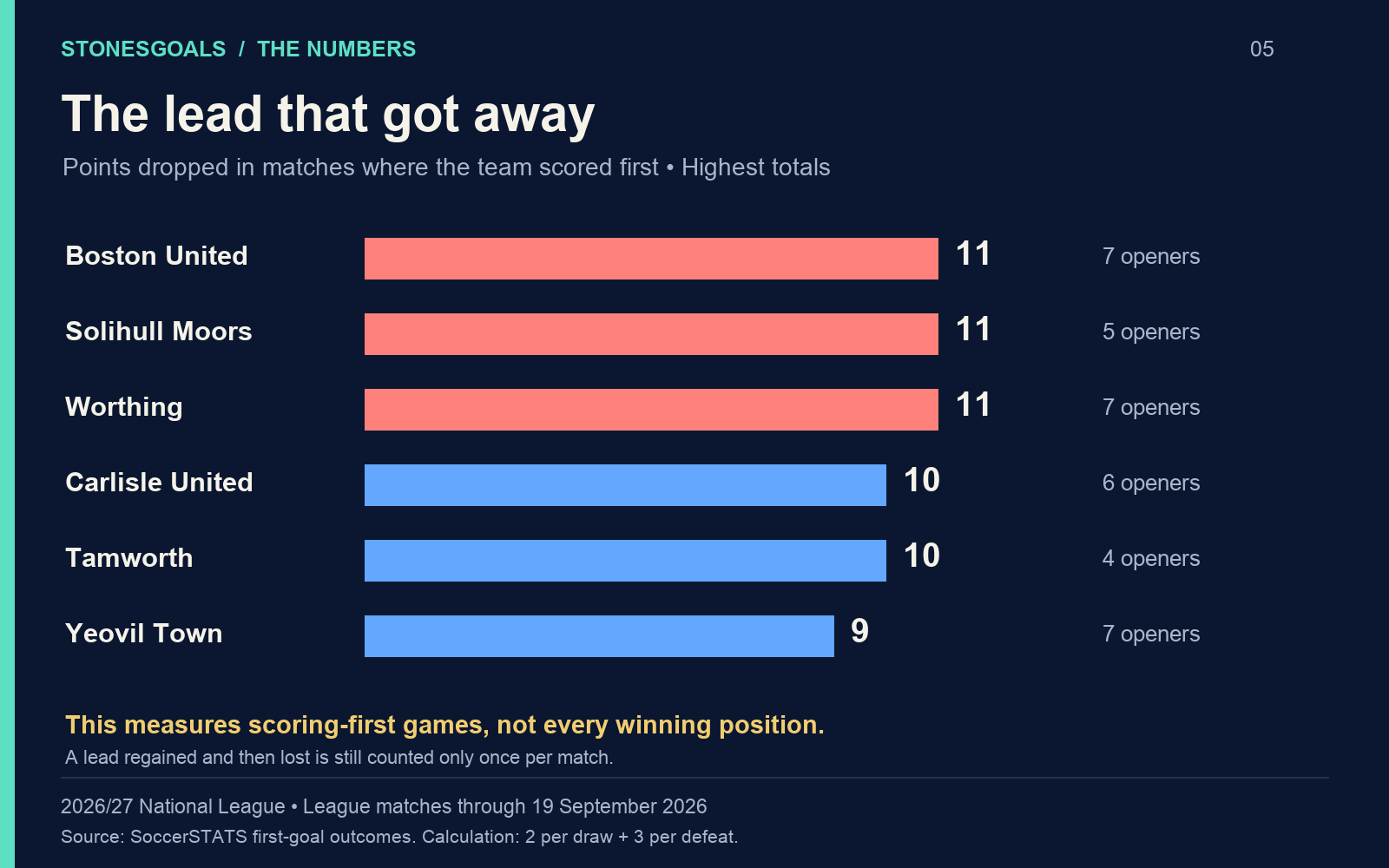
Those are points a side had put itself in position to compete for, not points it was owed. There is a difference. An early goal does not make the remaining match disappear, and this table cannot tell us whether the lead reflected the balance of play.
Boston have lived both sides of the argument
Against Hornchurch on Bank Holiday Monday, Boston led twice and still lost 3–2. The Urchins’ report describes the late recovery, finished by Bobby Kelman two minutes from time. Two opportunities to take command ended with nothing to show for them.
Wealdstone then won 3–1 at Boston after conceding the opener. But the Stones’ report adds an important detail: Baptiste saved a penalty before the visitors took control of the score. It is a reminder that a surrender can contain a decisive intervention from the opposition goalkeeper, as well as the defending team’s failings.
Calling every one of these results a collapse would be easy. Explaining them properly requires rather more care. The common outcome identifies a problem worth investigating; it does not supply a single diagnosis.
Worthing can repair the damage too
Worthing’s place near the top of this unwanted table does not make them incapable of a recovery. Against Barrow on 12 September, Mikey Lane scored twice before half-time. Dom Hutchinson replied in the 50th and 61st minutes to secure a 2–2 draw. Worthing’s match details record both braces.
That afternoon belongs on the other side of the ledger. Worthing rescued a point; Barrow let a winning position go. The same club can be wasteful with an advantage one week and admirably stubborn without one the next.
A lead still has to be defended
Yeovil’s trip to Southend provides the bluntest reminder. Two goals ahead in the second half, the Glovers were eventually beaten 3–2. Their match report describes Southend building pressure, getting back into the game through Oldaker and completing the turnaround through Chambers-Parillon and Omochere.
For supporters, these are the defeats that linger. The win was imaginable. For managers, the useful question is what changed after the advantage arrived: the opposition’s approach, the substitutions, the ability to retain possession or the quality of the chances conceded.
The numbers cannot choose between those explanations. They can tell clubs where to start looking. Getting in front has been possible. Staying there has been a much more selective skill.
Data note: Snapshot through 19 September 2026, not a live feed. Goal times use SoccerSTATS segment conventions; 31–45 and 76–90 include added time. Small samples and differing opponents limit causal conclusions. Linked club reports provide match context.