2026/27 National League. League matches through 19 September 2026; researched 23 September. Cups and friendlies excluded.
The queue for the exit can wait. This National League season has been saving an awful lot of its business for the end.
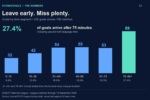
Of the 325 goals scored in the first 108 matches, 89 arrived after 75 minutes, including stoppage time. That is 27.4% of the total. More than one in four goals, packed into the final nominal quarter-hour and whatever the fourth official adds to it. League goal totals.
The biggest bar on the chart
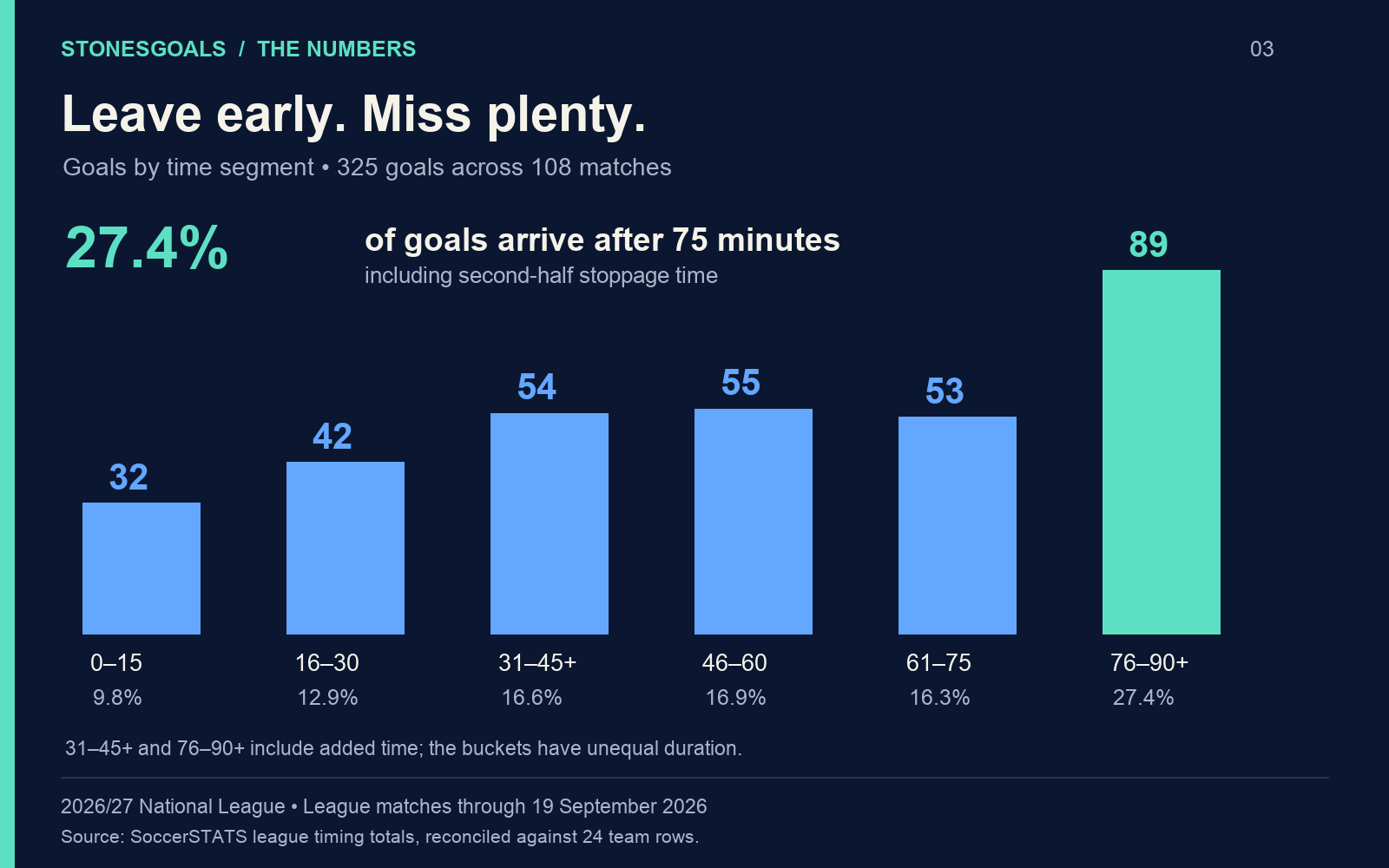
The second half accounts for 197 goals, compared with 128 before the interval. Yet the final segment stands apart even within that second-half total: the two preceding buckets contain 55 and 53. There is a clear late concentration. There is not, from this chart alone, a complete explanation for it.
Tired legs are an easy answer. So are substitutions, riskier defending and teams throwing players forward. Each is a plausible route to a late goal. None can be proved by a timestamp. The figures describe when the action happened; the match footage is where an explanation has to earn its place.
Boreham Wood know what to do with the time
Wood’s 2–1 win over Carlisle is a useful illustration. They trailed to Stephen Wearne’s goal on the hour, introduced Jay Bird and found the equaliser through their new striker before the winner followed shortly afterwards. A losing position became three points inside the closing stages.
That matters because a late goal is not automatically a consolation or the final decoration on an easy win. Sometimes it changes everything the table records about an afternoon.
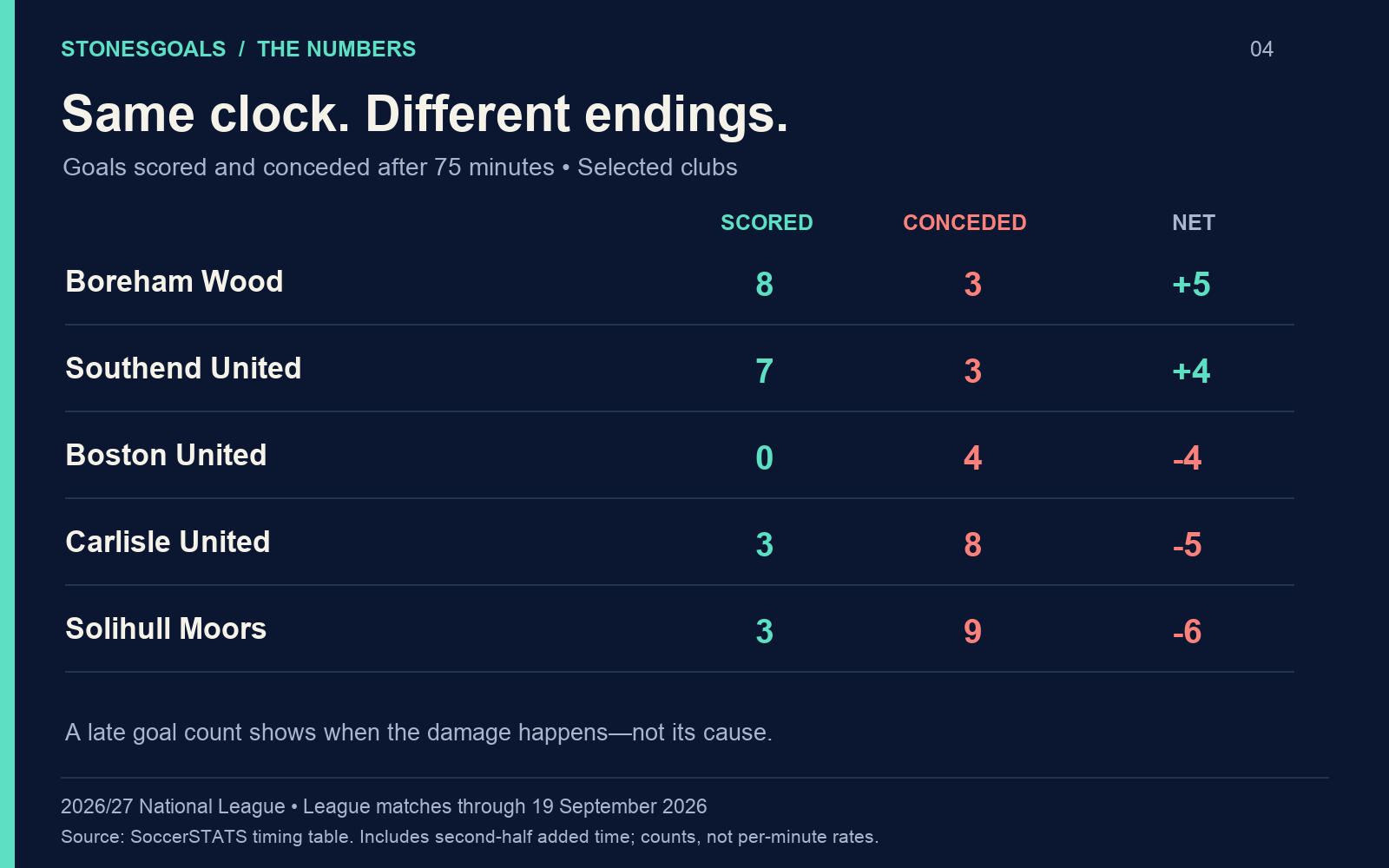
The club timing breakdown shows Wood at eight scored and three conceded after 75 minutes. Southend are seven and three. At the other end of this selected comparison, Boston have no goals scored and four conceded; Carlisle are three and eight; Solihull three and nine. The same part of the match is producing very different experiences.
And sometimes it changes everything twice
Halifax and Sutton supplied the less comfortable version on 19 September. The game remained goalless into added time. Halifax then went ahead in the fourth extra minute, only for David Ogbonna to equalise in the fifth. Sutton’s report records a match that appeared settled and then immediately refused to be.
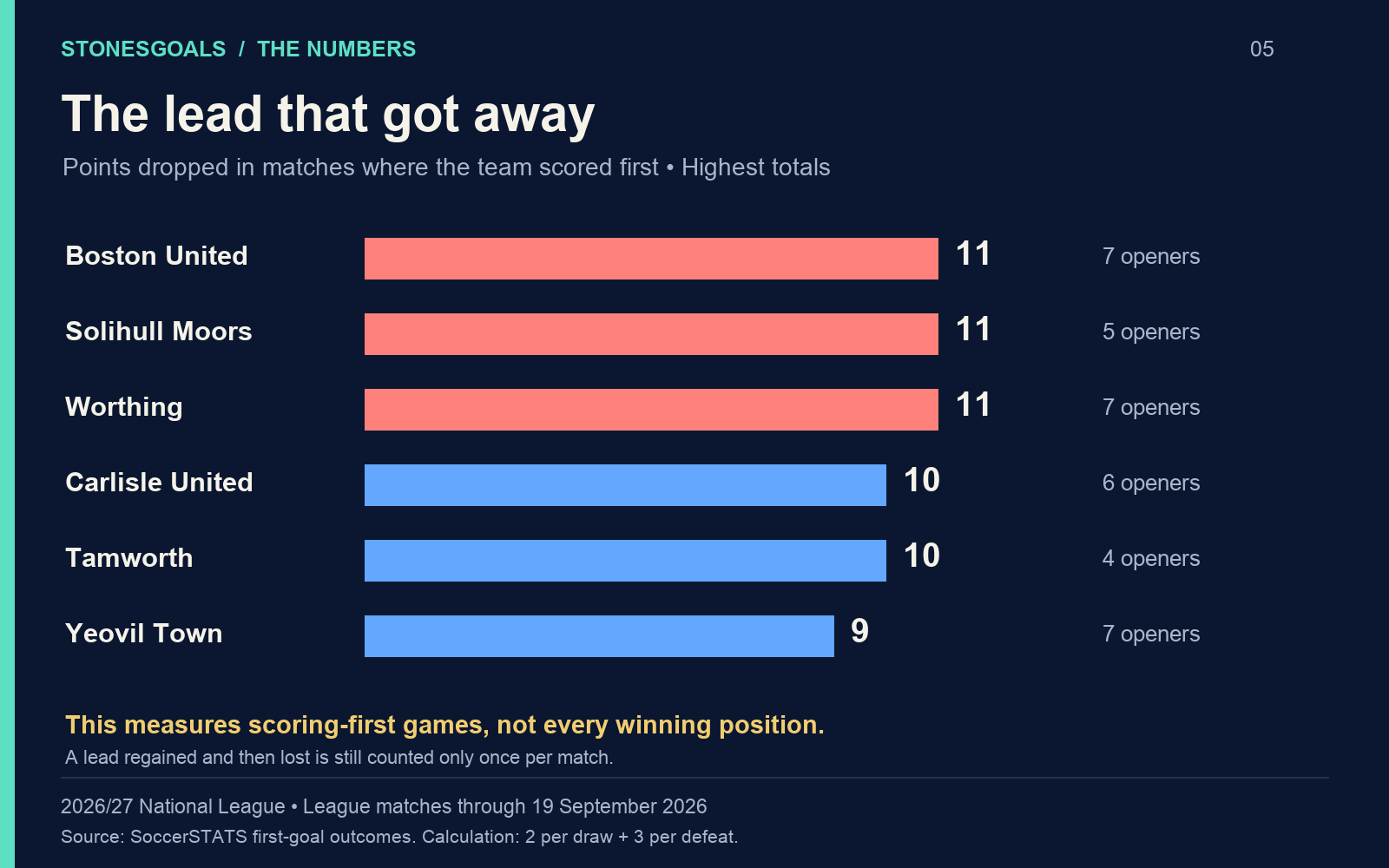
A comparison of the score at 75 minutes with the final score would show no net points change for either side. Both were drawing then. Both were drawing at the end. It would miss the winning position Halifax briefly held in between.
That is why the definition matters. Late goals, late points swings and surrendered leads are related stories, but they measure different things. A clean-looking number can conceal a wonderfully messy game.
Keep watching, keep the claim sensible
Southend’s comeback against Yeovil offers another reason to stay put: two goals down in the second half, then a free-kick to get back into it, an equaliser and a winner. The last two goals arrived after 75 minutes. A comfortable-looking away lead was gone.
There is no previous-season comparison here, so these figures do not establish that 2026/27 is unusually dramatic by National League standards. Nor do they promise another late winner next Saturday.
They do establish something simpler. In the opening nine rounds, the closing stages have contained a substantial share of the scoring. Leaving early has carried a fairly obvious cost.
Data note: Snapshot through 19 September 2026, not a live feed. Goal times use SoccerSTATS segment conventions; 31–45 and 76–90 include added time. Small samples and differing opponents limit causal conclusions. Linked club reports provide match context.